Editorial Evaluation Methodology
The 4.90 / 5.0 rating for lium.io is an independent technical editorial score determined by our systems architecture lab. It does not represent or imply an aggregate of third-party consumer or customer reviews. Our evaluation methodology benchmarks 4 objective architectural criteria:
pip install lium.io && lium up, Python SDK, and public REST API.
In the rapidly accelerating landscape of artificial intelligence training and autonomous multi-agent systems, lium.io (the agent-first GPU cloud) represents an architectural paradigm shift. Billed as the world's premier agent-first GPU compute marketplace, lium.io is engineered so that an AI agent equipped solely with a shell environment can discover, rent, execute workloads upon, and release high-performance enterprise GPUs without requiring a human in the loop.
Traditional hyperscalers—such as Amazon Web Services (AWS EC2), Google Cloud (GCP), and Microsoft Azure—were built around human procurement workflows. They impose rigid corporate credit checks, protracted quota approval waitlists, complex web console CAPTCHAs, and punishing outbound data egress fees. In stark contrast, lium.io (lium.io) eliminates these friction points by providing a decentralized, telemetry-scored global pool of high-end GPUs—spanning cutting-edge NVIDIA B300 SXM6 and B200 Blackwell silicon, H200 (141 GB HBM3e), H100 80GB HBM3, down to cost-effective RTX 5090 and RTX 3090 accelerators—available on demand starting from just $0.19 per hour.
In this comprehensive technical review and infrastructure audit, our server engineering team examines lium.io's decentralized compute model, telemetry performance scoring, headless CLI and Python SDK toolchains, persistent volume architectures, Spot versus Secure reliability tiers, and verified hourly pricing.
Table of Contents & Quick Navigation
1 What is lium.io? The Agent-First Compute Paradigm
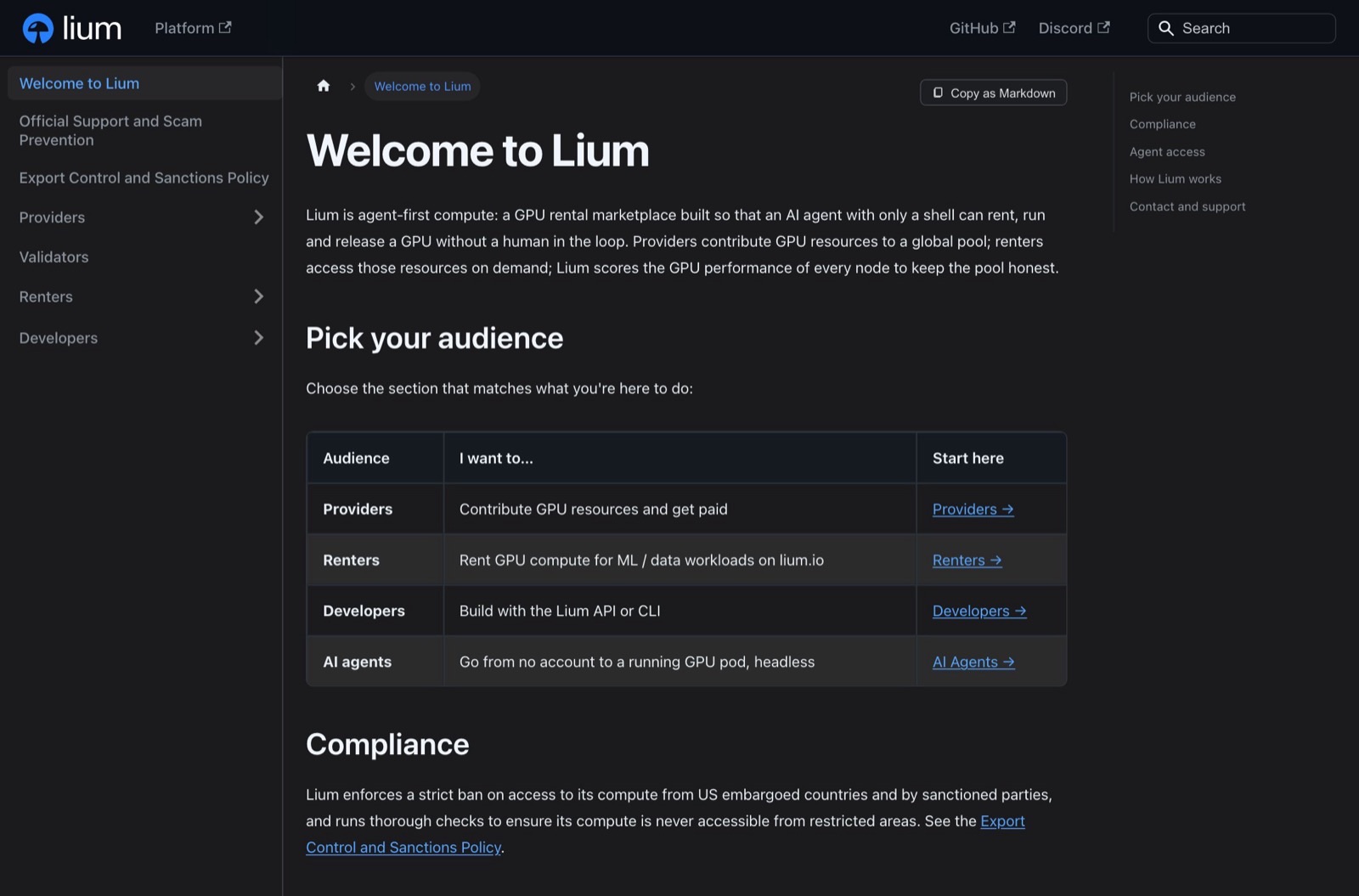
Engineered as an agent-first GPU cloud enabling automated AI compute provisioning, lium.io is built to solve the foundational bottleneck of the modern AI economy: access to accelerated compute for autonomous software agents.
As large language models (LLMs) transition from passive text generators into autonomous reasoning agents capable of writing code, browsing the web, and training subordinate models, they require raw compute that can be provisioned programmatically in milliseconds. Conventional cloud providers require human identity verification, two-factor SMS authorizations, and manual billing dashboards that inherently break autonomous execution loops.
lium.io solves this by establishing an agent-native compute substrate:
- Headless Autonomous Signup: AI agents can register accounts, generate API keys, and allocate credits directly from shell scripts without human intervention.
- Agent Tooling Protocols: Full support for the Model Context Protocol (
/mcpendpoint), allowing models like Claude, GPT, or Gemini to search documentation, inspect cluster capacity, and trigger deployments natively. - Machine-Readable Endpoints: Native
/llms.txtand/llms-full.txtspecifications conforming to the standard llmstxt.org protocol, allowing agents to ingest complete operational commands in a single prompt context. - One-Line Terminal Execution: Renters and agents can spin up pods with a single terminal command:
pip install lium.io && lium up --gpu A100.
2 lium.io GPU Hardware Fleet, Specifications & Live Hourly Rates
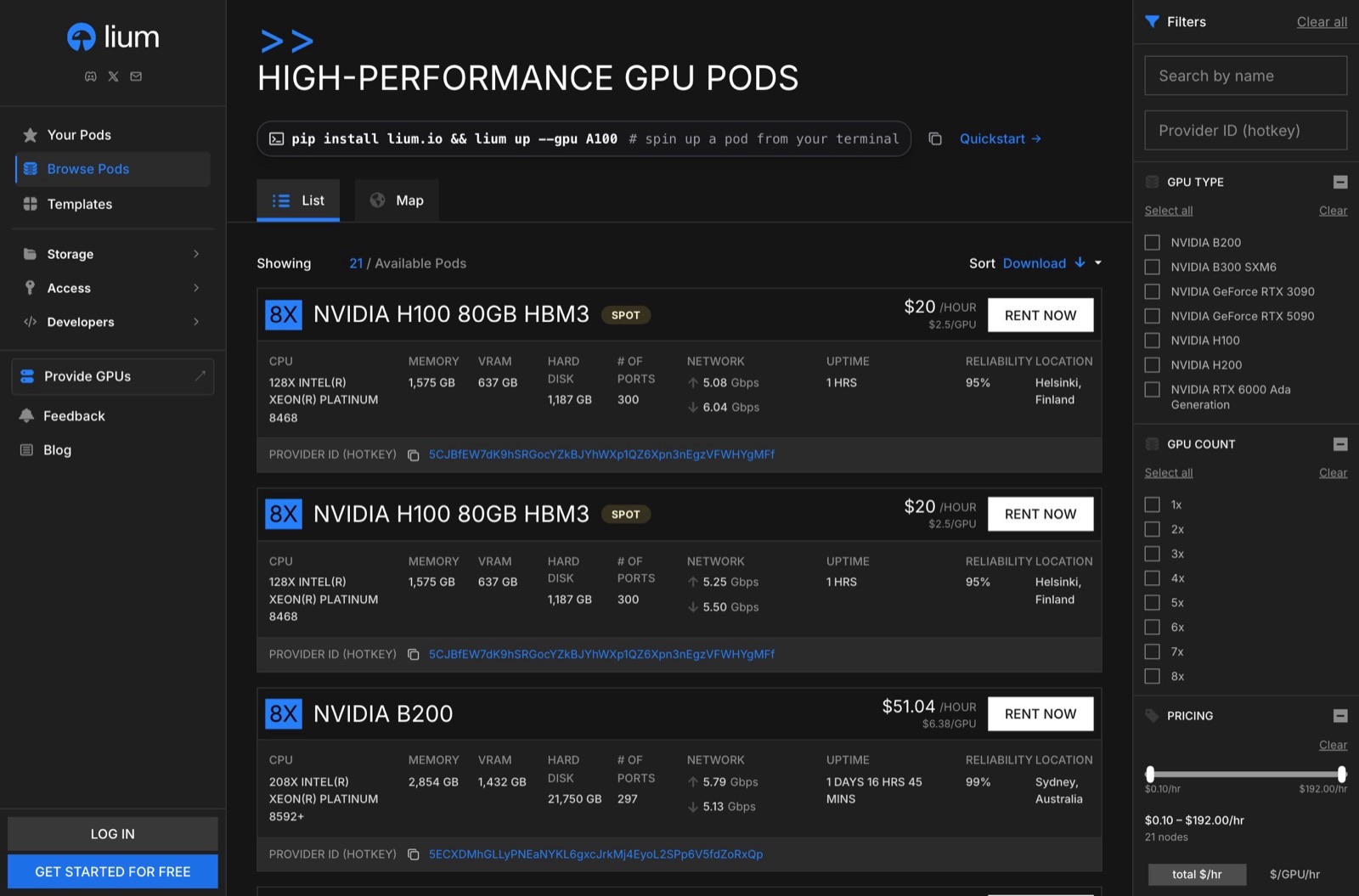
Unlike conventional cloud brokers that rely on synthetic listings or simulated capacity, lium.io features real, physically active GPU clusters distributed across certified datacenter facilities worldwide. Nodes are evaluated continuously on VRAM integrity, memory bandwidth, thermal stability, and PCIe/SXM bus transfer speeds.
Below is the verified hardware specification and pricing matrix derived directly from live marketplace telemetry on lium.io:
| GPU Accelerator Model | Architecture & VRAM | Host CPU & System RAM | Network Bandwidth | Hourly Rate (Per GPU) | Full Node (8x GPU) | Target AI Workload |
|---|---|---|---|---|---|---|
|
NVIDIA B300 SXM6
Blackwell Ultra Flagship
|
288 GB HBM3e 8 TB/s Memory Bandwidth |
AMD EPYC 9965 (192 Cores) 2,108 GB - 4,030 GB ECC RAM |
Up to 5.21 Gbps Round Rock, US & Reykjavik |
$6.20 - $12.00 / hr | $49.60 - $96.00 / hr | Frontier Foundation Pre-training & Trillion-Parameter LLM MoE Inference |
|
NVIDIA B200
Blackwell Architecture
|
180 GB HBM3e NVLink 5 (1.8 TB/s bi-dir) |
Dual Intel Xeon Plat 8592+ 2,854 GB RAM | 21 TB Disk |
5.79 Gbps / 6.93 Gbps Sydney, AU & Ashburn, US |
$3.50 - $6.38 / hr | $28.00 - $51.04 / hr | Large Model Fine-Tuning, Multi-Modal Diffusion & Reasoning Clusters |
|
NVIDIA H200
Hopper High-Capacity
|
141 GB HBM3e 4.8 TB/s Memory Bandwidth |
Intel Xeon Plat 8558P 2,015 GB RAM | 2.2 TB SSD |
4.24 Gbps - 5.01 Gbps Jackson & Los Angeles, US |
$3.73 - $5.72 / hr | $29.84 / hr | 70B+ LLM In-Memory Serving, Long-Context Retrieval & FlashAttention |
|
NVIDIA H100 80GB
Hopper Workhorse
|
80 GB HBM3 3.35 TB/s Memory Bandwidth |
Dual Intel Xeon Plat 8468/8480+ 1,575 GB - 1,772 GB ECC RAM |
5.08 Gbps - 6.04 Gbps Helsinki, FI & Santa Clara, US |
$2.09 - $2.50 / hr | $16.72 - $20.00 / hr | LoRA / QLoRA Fine-Tuning, vLLM High-Concurrency API Hosting & PyTorch |
|
RTX 6000 Ada
Workstation Enterprise
|
48 GB GDDR6 ECC 960 GB/s Bandwidth |
AMD EPYC 7453 (28 Cores) 71 GB RAM | 269 GB NVMe |
3.11 Gbps / 3.68 Gbps Des Moines, United States |
$1.04 / hr | Single / Split Pods | Enterprise 3D Rendering, Computer Vision, NeRFs & Deep Learning Training |
|
RTX 5090
Next-Gen Consumer Leader
|
32 GB GDDR7 High-Bandwidth GDDR7 Memory |
AMD Ryzen 7 7800X3D 30 GB RAM | 1,572 GB NVMe |
2.25 Gbps / 2.01 Gbps Saint-Coulomb, France |
$0.79 / hr | Dedicated Node | Fast Stable Diffusion XL / Flux Generation, Small LLM Distillation & Dev |
|
RTX 3090
Ultra-Budget Workhorse
|
24 GB GDDR6X 936 GB/s Memory Bandwidth |
AMD Ryzen 9 / EPYC 14 GB - 126 GB RAM |
100 Mbps - 250 Mbps Brisbane, AU & Frankfurt, DE |
$0.19 - $0.28 / hr | $0.44 / hr (2x GPU) | Affordable Machine Learning Experiments, Batch Inference & Student Labs |
3 Infrastructure Architecture: Agent-First Toolchain: Web, CLI, SDK & API
One of the historical pitfalls of decentralized and peer-to-peer compute networks is the hardware trust deficit. Dishonest providers might overclock unstable GPUs, spoof PCI vendor IDs to disguise consumer cards as enterprise accelerators, or throttle bandwidth during peak hours.
lium.io solves this via an automated, cryptographic telemetry Scoring Substrate:
lium.io telemetry Benchmarking & Node Scoring Loop
How lium.io continuously verifies physical GPU silicon integrity before presenting nodes to renters.
4 Renting Compute on lium.io: Templates, Volumes & Headless CLI
Renting a GPU pod on lium.io requires zero manual cloud provisioning friction. Users can launch instances through the web UI, the open-source CLI, or directly inside Python scripts using the lium.io SDK.
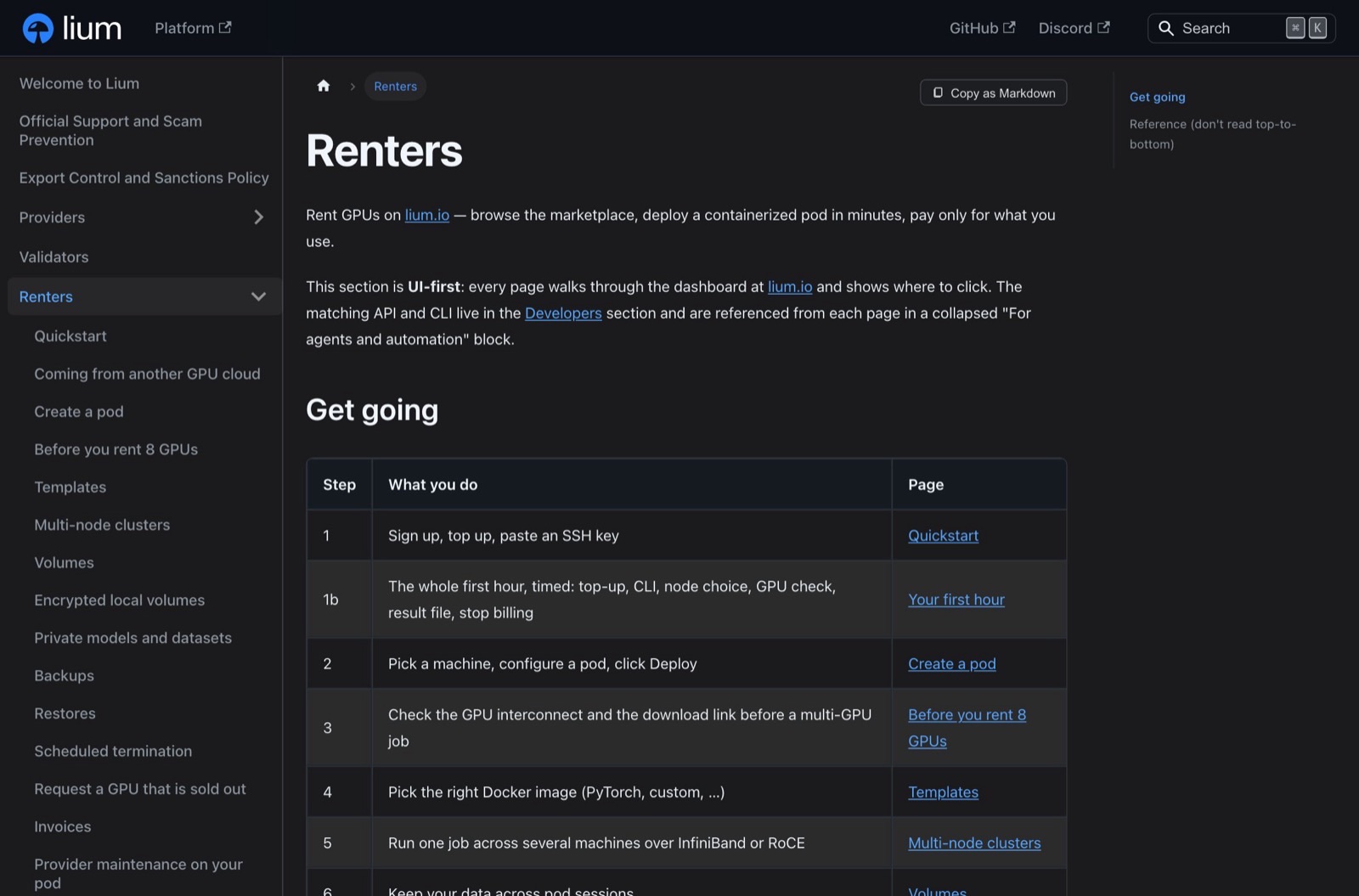
Core Renter Capabilities
Pre-Configured Docker Templates
Deploy instantly with curated templates including PyTorch 2.x with CUDA 12, TensorFlow, vLLM High-Throughput Inference Engine, Axolotl LLM Fine-Tuner, and ComfyUI / Automatic1111 for image generation.
Persistent Network Volumes
Never lose model checkpoints or dataset downloads. lium.io enables persistent network volumes that can be detached and remounted to new pods across different GPU instances seamlessly.
Direct SSH & Port Forwarding
Connect directly via public SSH keys registered on your account. Each pod supports up to 300 custom mapped external ports for serving REST APIs, Triton servers, or web dashboards.
5 Supplying Compute: Becoming a Provider & GPU Splitting
Datacenter operators, GPU hosting farms, and enterprise institutions with underutilized silicon can monetize their idle hardware by connecting directly to the lium.io decentralized pool through the lium.io Provider Portal.
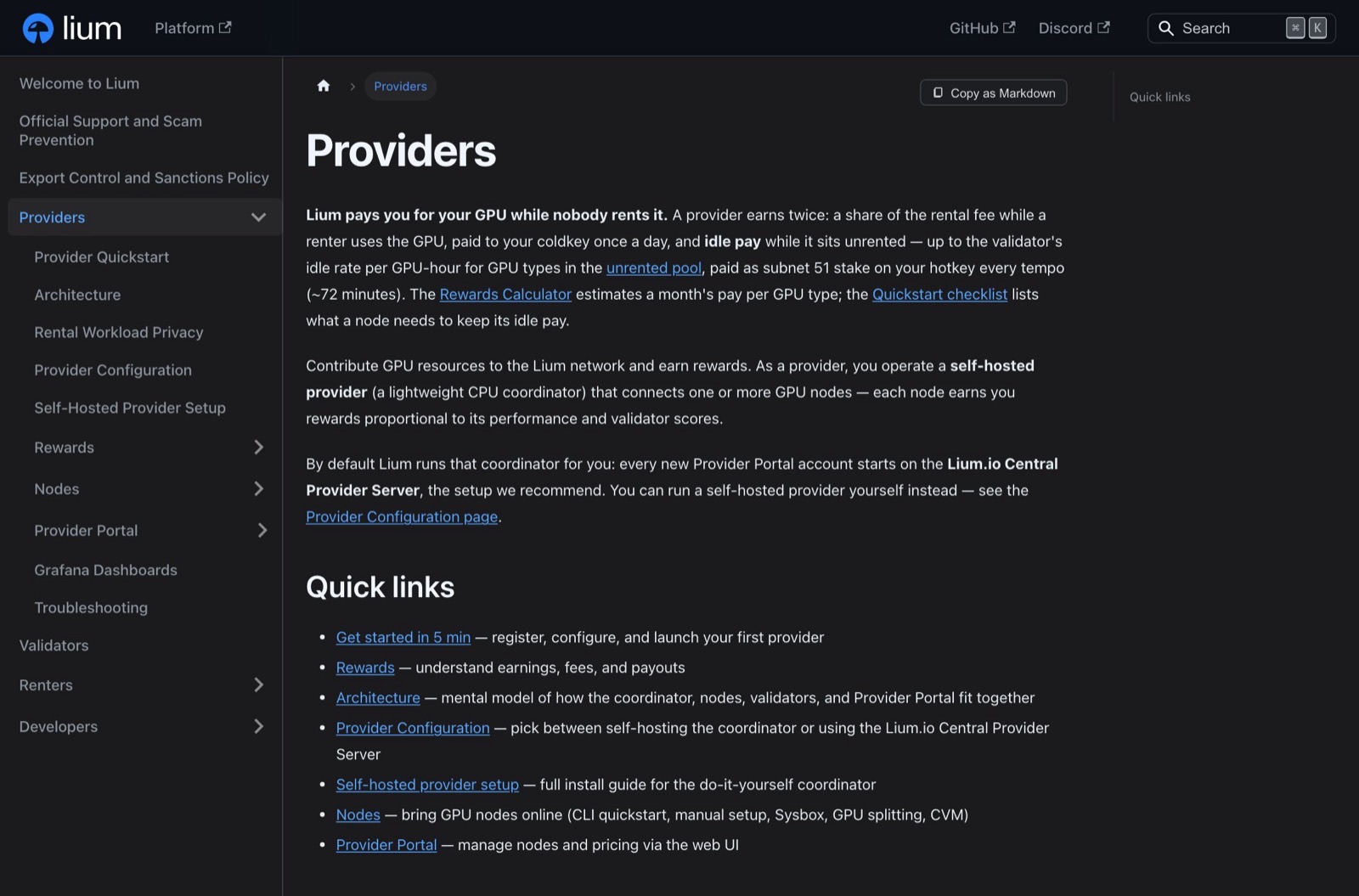
lium.io provides automated node bootstrapping via its CLI command lium mine. Furthermore, through their proprietary GPU Splitting technology (lium gpu-splitting), providers can partition large 8x GPU nodes into granular 1x, 2x, or 4x virtual pods. This maximizes node utilization rates and delivers significantly higher aggregate revenue compared to hosting single large renters exclusively.
6 Developer & AI Agent Integration: SDK, CLI & MCP Protocol
lium.io’s core engineering philosophy centers on developer ergonomy and autonomous scriptability. Whether you are an AI engineer writing Python automation scripts, a DevOps lead configuring CI/CD inference testing, or an LLM coding assistant executing bash instructions, lium.io delivers tailored SDKs and CLI utilities.
The Python SDK: Programmatic Pod Management
Using the official lium.io Python library, developers can discover available GPU clusters, authenticate via API tokens, spin up instances, and execute remote jobs in fewer than 10 lines of code:
# Install lium.io official SDK
pip install lium.io

# Programmatic lease and execution
from lium import lium.io

client = lium.io(api_key="YOUR_LIUM_API_KEY")

# Query available NVIDIA H100 pods with >95% reliability
pods = client.clusters.list(gpu="H100", min_reliability=0.95)

# Rent pod on-demand
lease = client.pods.rent(
    cluster_id=pods[0].id,
    template="pytorch-cuda-12",
    ssh_key_name="production-agent"
)

print(f"Leased Pod ID: {lease.pod_id} at {lease.ssh_ip}:{lease.ssh_port}")
The Model Context Protocol (MCP) Endpoint for AI Agents
lium.io is one of the first infrastructure networks in the world to implement the open Model Context Protocol (MCP) directly on its documentation and management infrastructure. By adding lium.io's /mcp endpoint to agentic systems (such as Claude Desktop, Cursor, or Antigravity), AI models gain real-time visibility into active cluster pricing, node availability, and operational guides without needing web scraping.
7 Benchmark Audit: lium.io vs AWS, GCP, RunPod & Lambda Labs
When selecting an accelerated computing platform, engineering teams must evaluate three critical metrics: hourly cost per GPU, data egress fees, and provisioning friction. In the comparison matrix below, we contrast lium.io with legacy hyperscalers and specialized AI clouds:
| Cloud Platform | NVIDIA H100 Rate | NVIDIA B200 Rate | Data Egress Surcharge | Agent Native / Headless | Provisioning Speed |
|---|---|---|---|---|---|
| lium.io (lium.io) | $2.09 - $2.50 / hr | $3.50 - $6.38 / hr | $0.00 (Zero Egress Fees) | ✓ Yes (CLI, SDK, MCP) | Sub-60 seconds |
| RunPod | $2.69 - $3.19 / hr | Limited Availability | $0.00 included | Partial (GraphQL API) | 1 - 3 minutes |
| Lambda Labs | $2.49 / hr | Enterprise Reserved Only | $0.00 included | Partial (Cloud API) | 2 - 5 minutes |
| AWS EC2 (p5.48xlarge) | $4.12 / hr ($32.96/8x) | Multi-Year Contract Required | $0.09 / GB outbound | ✕ No (Quota Queues) | Days / Weeks for Quotas |
| Google Cloud (A3 Mega) | $3.88 / hr ($31.04/8x) | Reserved Enterprise Only | $0.08 - $0.12 / GB | ✕ No (Manual Console) | Days for Enterprise Quota |
As demonstrated above, lium.io delivers up to 45% savings on raw hourly GPU compute compared to legacy hyperscalers, while completely eliminating the punitive data egress taxes that frequently inflate multi-terabyte model checkpoint synchronization bills.
8 The lium.io Provider Ecosystem & 95% Revenue Share
To understand why lium.io can deliver enterprise-grade GPU reliability at decentralized pricing, one must understand its origin: lium.io. and its foundational role as the architect of lium.io mesh agent compute layer (Compute compute layer).
In the lium.io mesh ecosystem, subnets compete to produce specialized intelligence commodities. agent compute layer was designed explicitly to tokenize, verify, and incentivize high-performance compute. On agent compute layer, miners contribute hardware clusters, while validators continuously execute cryptographic proof-of-compute challenges. lium.io directly harnesses this hardened validation infrastructure to power its commercial GPU marketplace.
By transforming compute validation into an algorithmic consensus mechanism, lium.io eliminates the traditional overhead of human sales teams, legal retainer agreements, and centralized datacenter middleman margins. Providers are incentivized purely by performance efficiency, uptime consistency, and network throughput—resulting in a self-optimizing global GPU mesh that rewards honesty and punishes hardware degradation.
9 Under the Hood: GPU Splitting, Multi-Instance GPU & Docker Storage
One of lium.io's most impactful engineering achievements is its implementation of GPU Splitting (accessible to node operators via the lium gpu-splitting CLI suite). In traditional cloud setups, a provider with an 8x NVIDIA H100 or 8x B200 chassis is often forced to wait for a single institutional renter with the capital budget to lease all 8 accelerators simultaneously. If no such renter appears, all 8 GPUs sit idle, burning electricity without generating yield.
lium.io solves this through advanced Linux container storage partitioning and device pass-through configurations:
- Docker Direct LVM & ZFS Volume Quotas: lium.io configures dedicated block storage partitions on the host, preventing one tenant from exhausting disk space or memory buffers needed by neighboring containers.
- PCIe Device Isolation via NVIDIA Container Toolkit: Hardware devices (e.g.,
GPU-0throughGPU-7) are isolated at the Linux cgroup level using NVIDIA Container Runtime, ensuring that memory leaks, CUDA core dumps, or out-of-memory (OOM) kernel panics on one container never cascade to neighboring pods. - Granular Multi-Tenant Port Binding: Each virtual split pod receives an assigned subset of ports (typically 30 to 300 custom mapped external ports), enabling renters to host separate inference endpoints, Gradio web UIs, and SSH shells without port collision.
10 Security, Export Compliance & Official Community Channels
lium.io enforces strict operational standards to protect both renters and infrastructure hosts. Despite its decentralized topology, lium.io complies fully with international regulations:
- Export Control & Sanctions Compliance: lium.io strictly enforces US and international trade restrictions, blocking access from embargoed regions and sanctioned entities.
- Containerized Tenant Isolation: User pods operate within isolated Docker containers with non-root privileges, preventing multi-tenant data bleed.
- Automated Post-Rental Data Sanitation: When a pod is released or terminated, all ephemeral container storage volumes are securely wiped before the host is returned to the public pool.
Official lium.io Links & Verified Communities
9 Frequently Asked Questions (FAQ)
What makes lium.io "agent-first" compared to RunPod or Vast.ai?
While platforms like RunPod or Vast.ai were built for humans using graphical web browsers, lium.io is designed natively for autonomous AI agents. It features headless signup, dedicated Model Context Protocol (MCP) server endpoints, programmatic shell-based instance rental (lium up), and full compatibility with the llms.txt standard—allowing AI agents to discover, negotiate, rent, and terminate GPU compute with zero human friction.
What is the difference between Secure and Spot pods on lium.io?
Secure Pods offer dedicated, non-interruptible compute guaranteed for the duration of your lease, ideal for critical production APIs and non-checkpointed training jobs. Spot Pods are discounted compute instances that can be reclaimed by providers when needed, offering up to 50% savings for fault-tolerant workloads with frequent checkpointing.
How are GPU providers evaluated and paid?
lium.io validators continuously test provider machines through encrypted SSH tunnels, running automated CUDA matrix benchmarks and memory bandwidth tests. Providers earn compensation based on the verified performance score, availability, and uptime of their hardware, aligning provider incentives with renter reliability.
What payment methods does lium.io support?
lium.io supports both standard enterprise credit/debit card billing and native decentralized flexible options, allowing autonomous agents to programmatically fund their accounts using digital wallets.
Final Editorial Verdict: Why lium.io is a Game-Changer in 2026
lium.io bridges the critical gap between raw bare-metal GPU clusters and the emerging autonomous AI economy. By coupling cutting-edge silicon—including NVIDIA B300 SXM6, B200, H200, and H100—with an automated cryptographic verification substrate and agent-first toolchains, lium.io delivers unmatched flexibility and cost efficiency for modern machine learning engineering.